
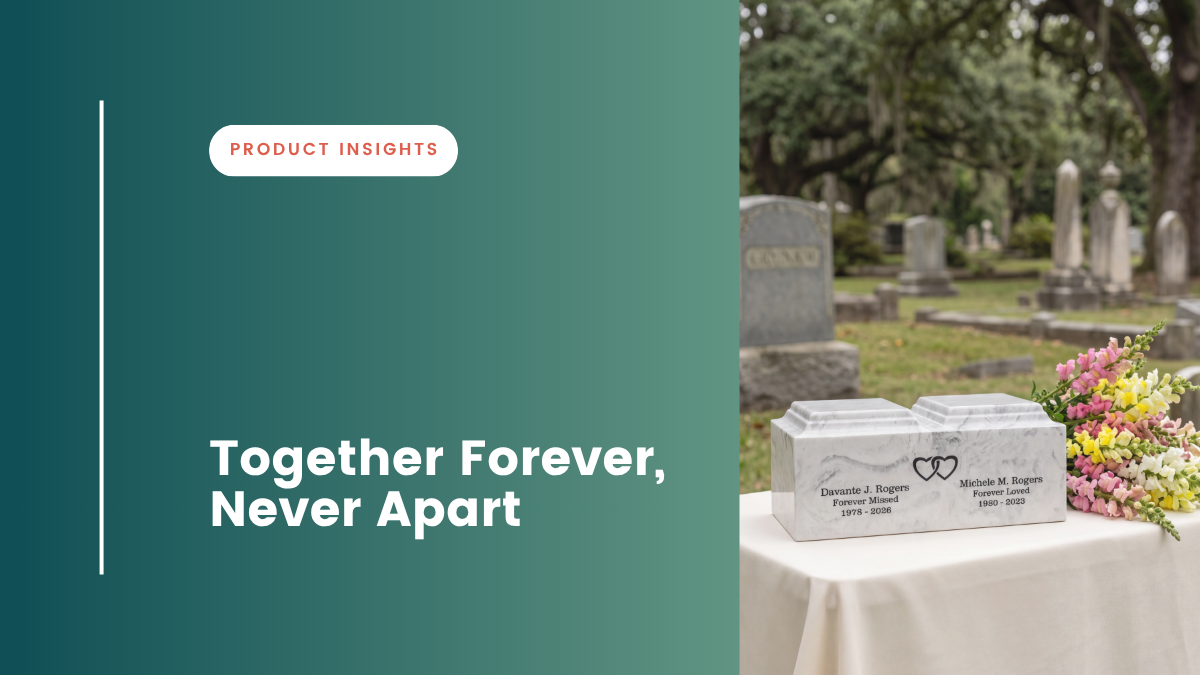
Some bonds last a lifetime and continue to resonate beyond death, and at Reflections Urns & Memorials we believe that such inseparability deserves memorial options designed specifically to honor those relationships. As a seasoned funeral director, you can provide invaluable guidance to people who may not even be aware that cremation urns, jewelry, and other options are available to highlight their bond.
So what are the most fundamental considerations to discuss with families?
- Does the family or couple want two separate compartments or a single, shared chamber?
Reflections offers companion urns with single or double chambers to suit different preferences.
- What is the capacity of their chosen companion urn, and will the deceased both fit?
Generally, our companion urns hold between 350 - 490 cubic inches of cremated remains. You can verify -- before providing urn choices -- that both persons' cremated remains will be accommodated by that size.
- Is the family planning to keep the urn in the home, bury it, or place it in a columbarium?
When helping a family choose a companion urn, you will want to get a sense for their plans for burial or display. As you know, companion urns being buried must follow cemetery restrictions -- which may dictate the family's choice. Companion urns being displayed or put in a niche may open up the selection.
Regardless of what the family plans to do with the urn, it’s important to let them know that personalization is still an option.
- Does the family want any personalization?
When the cremated remains of two individuals are to be placed in a companion urn, personalization can require a more strategic approach than a single urn.
Engraving a Companion Urn
When both individuals have passed:
When both individuals have already passed, we engrave companion urns similarly to single capacity urns: generally including the names, birthdates, and death dates of both individuals, along with any artwork and sentiments requested.
When both partners are still living:
In this situation, engraving can become a bit more complicated without the death dates of the individuals. Since there are no death dates yet to engrave, we recommend using the names and birthdates of each individual, while leaving out death dates entirely. Or, if the individuals are spouses, some couples opt to include their wedding dates instead of death dates. You can suggest this approach as a two-fold solution: the first being that this method is much simpler than having to add death dates whenever both individuals have passed. The second being that this is an innovative way to further emphasize companionship by memorializing the couple’s date of union rather than the date of their farewell.
When only one partner has passed:
We’ve found that engraving only one death date on a companion urn can lead to complications down the line.These may include:
- Having to either find the same company that engraved the initial inscription, or find a different company willing to add onto the inscription done by another company.
- Mailing the urn back to an engraver - which can be costly given the larger sizes of companion urns.
- Having to match the style, size, and placement of the initial engraving.
Our suggested alternative approaches are:
- Leave off death dates completely, and possibly birth dates as well.
- If the family is set on including death dates, we recommend leaving a blank space for these dates to be added with a metal plate instead of direct engraving (this allows for a more uniform look with matching fonts, sizing, and application of the death dates).
- Engrave the couple’s wedding date
- Engrave the amount of years the couple was together.
- Engrave the dates in which they were married through the first partner’s death date.
- Engrave roles instead of dates, such as “Husband," "Father," “Loving Partner," etc.